Cardinalfish
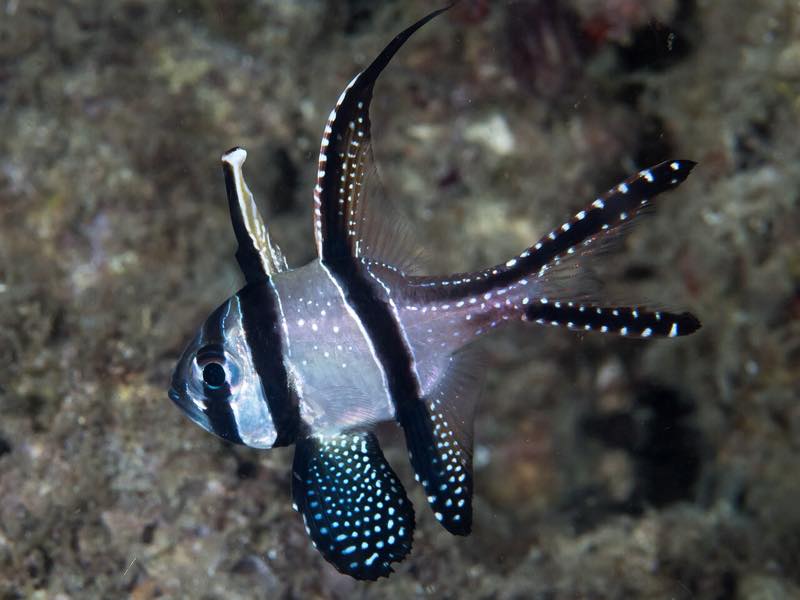
Banggai cardinalfish
Pterapogon kauderni
Also sold as Kaudern's cardinal, Longfin cardinalfish
Good first fish

- Care level
- Beginner
- Adult size
- 7.6 cm in aquariums
- Minimum tank
- 114 litres
- Temperament
- Mostly peaceful
- With corals
- Reef safe
- Captive-bred
- Widely sold captive-bred
- IUCN status
- Endangered
How do you care for the banggai cardinalfish?
Semi-aggressive towards its own kind; peaceful to others.
Feeding
Carnivore.
Captive-bred fish eat frozen and pellet foods.
Tank and special needs
Plan for at least 114 litres of water (the care sheet says 30 US gallons).
Calm water areas; likes long-spined urchins or branching coral to hover by.
Why this care level
Captive-bred only; wild fish are not beginner fish because of import losses.
Corals and invertebrates
None.
Which tankmates suit the banggai cardinalfish?
Do not keep large groups; pairs or a single fish. Males mouthbrood.
Suggested order in a mixed tank: add after the first peaceful fish.
More than one banggai cardinalfish
Only as a mated pair, or two juveniles added together. A third banggai cardinalfish is usually driven out.
Other fish
Checked against the other 59 fish in this guide, assuming a tank big enough for both. Individual fish differ, so treat this as a starting point.
Usually fine together (59)
- Ocellaris clownfish
- Percula clownfish
- Clark's anemonefish
- Tomato clownfish
- Maroon clownfish
- Neon goby
- Yellow clown goby
- Yellow watchman goby
- Orange spotted goby
- Hi-fin red banded goby
- Gold head sleeper goby
- Rainford's goby
- Lawnmower blenny
- Bicolor blenny
- Midas blenny
- Tailspot blenny
- Striped fang blenny
- Royal dottyback
- Orchid dottyback
- Magenta dottyback
- Neon dottyback
- Pyjama cardinalfish
- Green chromis
- Yellowtail blue damsel
- Blue damsel
- Azure damsel
- Humbug damsel
- Yellow coris wrasse
- Six line wrasse
- Red head solon fairy wrasse
- Carpenter's flasher wrasse
- Melanurus wrasse
- Leopard wrasse
- Bluestreak cleaner wrasse
- Firefish
- Purple firefish
- Scissortail dartfish
- Lyretail anthias
- Bartlett's anthias
- Royal gramma
- Yellow assessor
- Yellow tang
- Regal blue tang
- Kole tang
- Scopas tang
- Powder blue tang
- Coral beauty
- Flame angelfish
- Cherub angelfish
- Foxface rabbitfish
- Flame hawkfish
- Longnose hawkfish
- Falco hawkfish
- Yellowhead jawfish
- Mandarin dragonet
- Spotted mandarin
- Moorish idol
- Harlequin filefish
- Copperband butterflyfish
Invertebrates
Only the invertebrates with a known risk are listed.
Take care (2)
- Tiger tail sea cucumberA stressed or dead tiger tail sea cucumber can release toxins that harm fish; cover pump intakes.
- Sea appleA stressed or dead sea apple can release toxins that harm fish; cover pump intakes.
Corals and anemones
Only the corals and anemones with a known risk are listed.
Take care (1)
- Carpet anemones (Haddon's, giant)The carpet anemones (Haddon's, giant) can catch and eat small fish such as the banggai cardinalfish.
These checks follow the reasons fish and invertebrates clash: same species or genus, similar shape, mouth size, temperament, food, burrows, tank size and the order they are added. Individual animals differ; every source agrees on that.
Quarantine and health
Wild-caught imports have suffered iridovirus outbreaks with reported losses over 50% within 4 to 6 weeks (trade reports). typical, check
New fish are the most common way disease gets into a reef tank. Quarantine every fish in a separate tank before it joins the display, and choose a method that suits its tolerance of copper.
Captive-bred or wild?
Bred at scale (one Thai farm reported over 100,000 a year; TMC in the UK has supplied captive-bred fish). Endangered on the IUCN Red List; buy captive-bred only.
IUCN Endangered; wild population reported much reduced by collection. A CITES Appendix II listing was proposed in 2007 and not adopted, and the species was discussed again around the 2016 CITES meeting (outcome not confirmed); the US listed it as threatened under the Endangered Species Act (2016). typical, check
What does it cost in the UK?
about £24. This is one UK retailer’s listing on 21 October 2026, not a market average, and every item was sold out on that day.
Sources
Last checked . How we check
Found a mistake? Tell us how to fix it.
Related fish
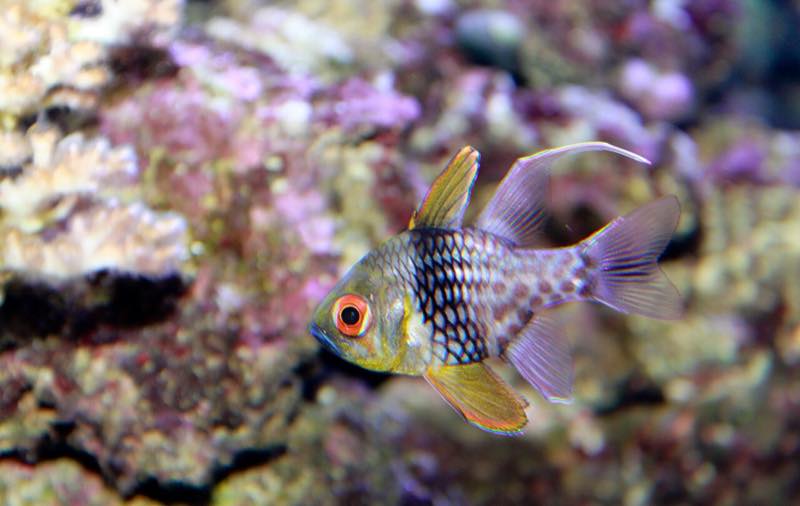
Pyjama cardinalfish
Sphaeramia nematoptera
Good first fish
- Care
- Beginner
- Adult size
- 9 cm
- Tank from
- 76 litres
- Temperament
- Peaceful
- Corals
- Reef safe
Photo Brian Gratwicke, CC BY 2.0