Dwarf angelfish
Flame angelfish
Centropyge loricula
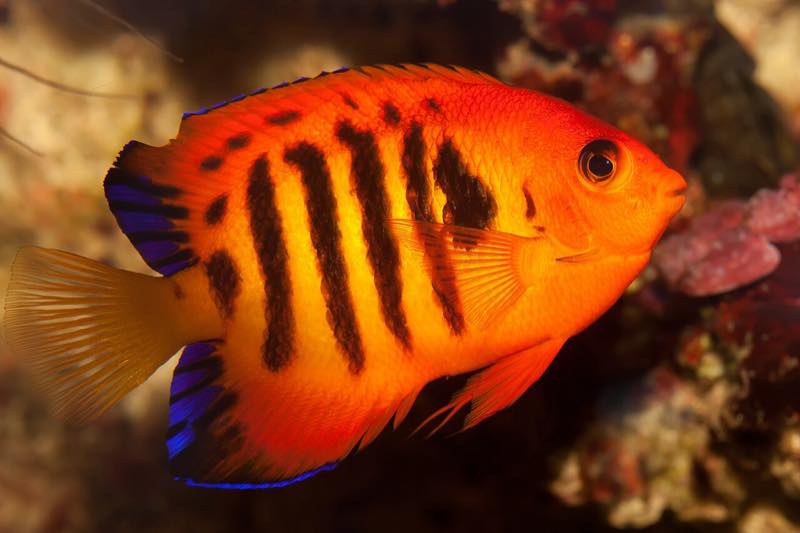

- Care level
- Intermediate
- Adult size
- 10.2 cm in aquariums
- Minimum tank
- 265 litres
- Temperament
- Semi-aggressive
- With corals
- Reef safe with caution
- Captive-bred
- Occasionally captive-bred
- IUCN status
- Least Concern
How do you care for the flame angelfish?
Semi-aggressive.
Feeding
Omnivore.
Grazer.
Tank and special needs
Plan for at least 265 litres of water (the care sheet says 70 US gallons). FishBase records wild fish up to 15 cm (total length); aquarium fish usually stay nearer 10.2 cm.
Live rock.
Corals and invertebrates
Stony and soft corals, sessile invertebrates, clam mantles.
Which tankmates suit the flame angelfish?
Add last; one dwarf angel per tank.
Suggested order in a mixed tank: add last, after the peaceful fish have settled.
More than one flame angelfish
Keep one flame angelfish: two of the same species usually fight.
Other fish
Checked against the other 59 fish in this guide, assuming a tank big enough for both. Individual fish differ, so treat this as a starting point.
Avoid together (2)
- Coral beautyBoth are Centropyge; close relatives defend the same space and food.
- Cherub angelfishBoth are Centropyge; close relatives defend the same space and food.
Usually fine together (57)
- Ocellaris clownfish
- Percula clownfish
- Clark's anemonefish
- Tomato clownfish
- Maroon clownfish
- Neon goby
- Yellow clown goby
- Yellow watchman goby
- Orange spotted goby
- Hi-fin red banded goby
- Gold head sleeper goby
- Rainford's goby
- Lawnmower blenny
- Bicolor blenny
- Midas blenny
- Tailspot blenny
- Striped fang blenny
- Royal dottyback
- Orchid dottyback
- Magenta dottyback
- Neon dottyback
- Banggai cardinalfish
- Pyjama cardinalfish
- Green chromis
- Yellowtail blue damsel
- Blue damsel
- Azure damsel
- Humbug damsel
- Yellow coris wrasse
- Six line wrasse
- Red head solon fairy wrasse
- Carpenter's flasher wrasse
- Melanurus wrasse
- Leopard wrasse
- Bluestreak cleaner wrasse
- Firefish
- Purple firefish
- Scissortail dartfish
- Lyretail anthias
- Bartlett's anthias
- Royal gramma
- Yellow assessor
- Yellow tang
- Regal blue tang
- Kole tang
- Scopas tang
- Powder blue tang
- Foxface rabbitfish
- Flame hawkfish
- Longnose hawkfish
- Falco hawkfish
- Yellowhead jawfish
- Mandarin dragonet
- Spotted mandarin
- Moorish idol
- Harlequin filefish
- Copperband butterflyfish
Invertebrates
Only the invertebrates with a known risk are listed.
Take care (2)
- Tiger tail sea cucumberA stressed or dead tiger tail sea cucumber can release toxins that harm fish; cover pump intakes.
- Sea appleA stressed or dead sea apple can release toxins that harm fish; cover pump intakes.
Corals and anemones
Only the corals and anemones with a known risk are listed.
Take care (41)
- ZoanthidsFlame angelfish may nip soft corals, more so when underfed.
- PalythoaFlame angelfish may nip soft corals, more so when underfed.
- Mushroom coralFlame angelfish may nip soft corals, more so when underfed.
- Hairy mushroomFlame angelfish may nip soft corals, more so when underfed.
- Florida ricordeaFlame angelfish may nip soft corals, more so when underfed.
- Yuma ricordeaFlame angelfish may nip soft corals, more so when underfed.
- Toadstool leatherFlame angelfish may nip soft corals, more so when underfed.
- Finger leatherFlame angelfish may nip soft corals, more so when underfed.
- XeniaFlame angelfish may nip soft corals, more so when underfed.
- Pulsing xeniaFlame angelfish may nip soft corals, more so when underfed.
- Waving hand coralFlame angelfish may nip soft corals, more so when underfed.
- Green star polypsFlame angelfish may nip soft corals, more so when underfed.
- Clove polypsFlame angelfish may nip soft corals, more so when underfed.
- Kenya treeFlame angelfish may nip soft corals, more so when underfed.
- Hammer coralFlame angelfish may nip LPS corals, more so when underfed.
- Frogspawn coralFlame angelfish may nip LPS corals, more so when underfed.
- Torch coralFlame angelfish may nip LPS corals, more so when underfed.
- Duncan coralFlame angelfish may nip LPS corals, more so when underfed.
- AcanFlame angelfish may nip LPS corals, more so when underfed.
- FaviaFlame angelfish may nip LPS corals, more so when underfed.
- FavitesFlame angelfish may nip LPS corals, more so when underfed.
- Chalice coralFlame angelfish may nip LPS corals, more so when underfed.
- BlastomussaFlame angelfish may nip LPS corals, more so when underfed.
- Candy cane coralFlame angelfish may nip LPS corals, more so when underfed.
- Bubble coralFlame angelfish may nip LPS corals, more so when underfed.
- GonioporaFlame angelfish may nip LPS corals, more so when underfed.
- AlveoporaFlame angelfish may nip LPS corals, more so when underfed.
- Open brain coralFlame angelfish may nip LPS corals, more so when underfed.
- LoboFlame angelfish may nip LPS corals, more so when underfed.
- GalaxeaFlame angelfish may nip LPS corals, more so when underfed.
- Scroll coralFlame angelfish may nip LPS corals, more so when underfed.
- Montipora capricornisFlame angelfish may nip SPS corals, more so when underfed.
- Montipora digitataFlame angelfish may nip SPS corals, more so when underfed.
- AcroporaFlame angelfish may nip Acropora, more so when underfed.
- Acropora milleporaFlame angelfish may nip Acropora, more so when underfed.
- PocilloporaFlame angelfish may nip SPS corals, more so when underfed.
- StylophoraFlame angelfish may nip SPS corals, more so when underfed.
- Birdsnest coralFlame angelfish may nip SPS corals, more so when underfed.
- Horn coralFlame angelfish may nip SPS corals, more so when underfed.
- Fire coral (not Acropora millepora)Flame angelfish may nip SPS corals, more so when underfed.
- Carpet anemones (Haddon's, giant)The carpet anemones (Haddon's, giant) can catch and eat small fish such as the flame angelfish.
These checks follow the reasons fish and invertebrates clash: same species or genus, similar shape, mouth size, temperament, food, burrows, tank size and the order they are added. Individual animals differ; every source agrees on that.
Quarantine and health
Very copper sensitive: keep below 0.15 ppm (LiveAquaria).
New fish are the most common way disease gets into a reef tank. Quarantine every fish in a separate tank before it joins the display, and choose a method that suits its tolerance of copper.
Captive-bred or wild?
Occasionally captive-bred; mostly wild.
Where sources disagree
| Topic | What sources say | Our reading |
|---|---|---|
| Adult size |
| As with other fish, the FishBase figure is a wild maximum. |
What does it cost in the UK?
about £215. This is one UK retailer’s listing on 21 October 2026, not a market average, and every item was sold out on that day. Hawaii and Pacific supply limits push UK prices up.
Sources
Last checked . How we check
Found a mistake? Tell us how to fix it.
Related fish
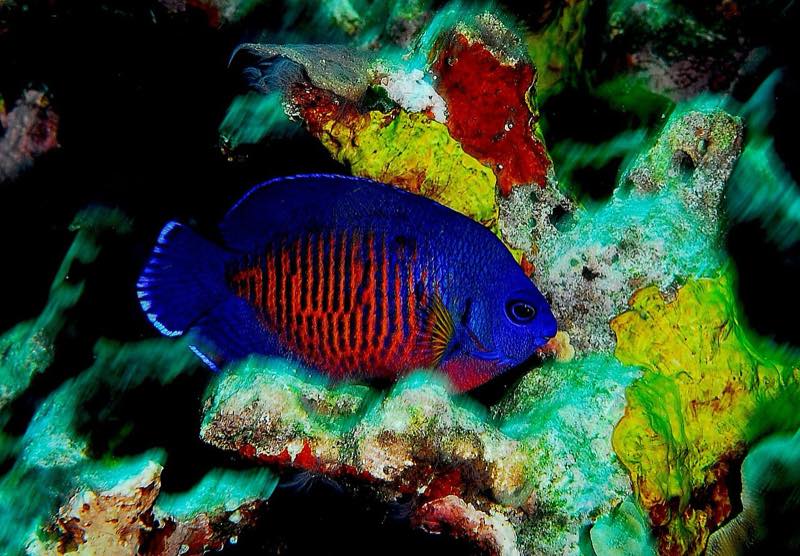
Coral beauty
Centropyge bispinosa
- Care
- Intermediate
- Adult size
- 12 cm
- Tank from
- 265 litres
- Temperament
- Semi-aggressive
- Corals
- Reef safe with caution
Photo Jenny Huang, CC BY 2.0
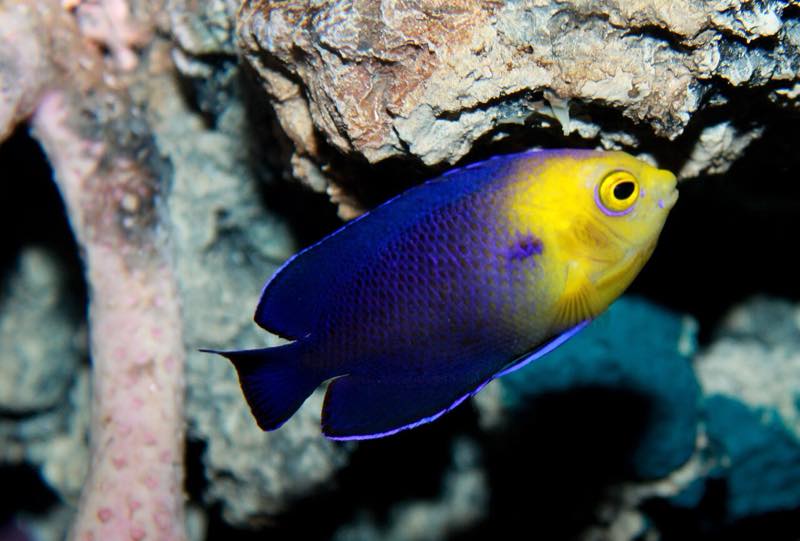
Cherub angelfish
Centropyge argi
- Care
- Intermediate
- Adult size
- 8 cm
- Tank from
- 189 litres
- Temperament
- Semi-aggressive
- Corals
- Reef safe with caution
Photo Brian Gratwicke, CC BY 2.0