Dwarf angelfish
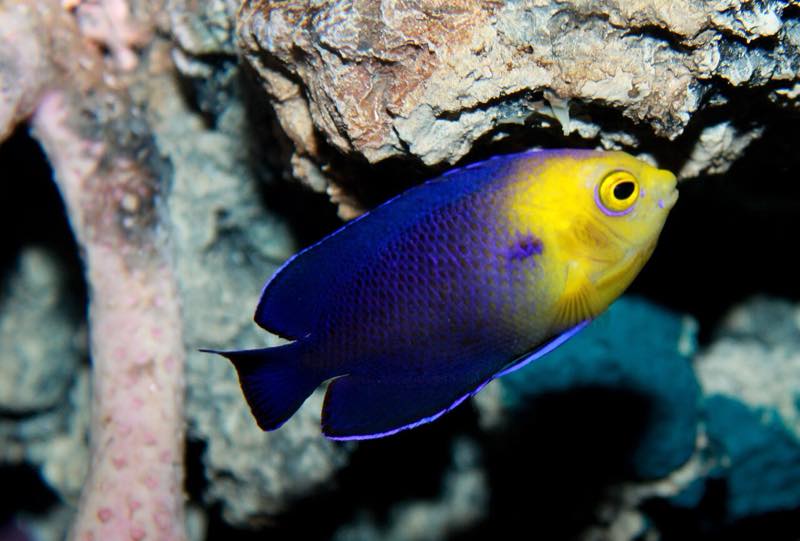
Cherub angelfish
Centropyge argi
Also sold as Pygmy angelfish, Cherubfish

- Care level
- Intermediate
- Adult size
- 7.6 cm in aquariums
- Minimum tank
- 189 litres
- Temperament
- Semi-aggressive
- With corals
- Reef safe with caution
- Captive-bred
- Occasionally captive-bred
- IUCN status
- Least Concern
How do you care for the cherub angelfish?
Semi-aggressive; males fight to the death.
Feeding
Omnivore.
Grazes microalgae.
Tank and special needs
Plan for at least 189 litres of water (the care sheet says 50 US gallons).
Live rock.
Corals and invertebrates
LPS and clam mantles.
Which tankmates suit the cherub angelfish?
One male per tank; a pair possible.
Suggested order in a mixed tank: add last, after the peaceful fish have settled.
More than one cherub angelfish
Keep one cherub angelfish: two of the same species usually fight.
Other fish
Checked against the other 59 fish in this guide, assuming a tank big enough for both. Individual fish differ, so treat this as a starting point.
Avoid together (2)
- Coral beautyBoth are Centropyge; close relatives defend the same space and food.
- Flame angelfishBoth are Centropyge; close relatives defend the same space and food.
Usually fine together (57)
- Ocellaris clownfish
- Percula clownfish
- Clark's anemonefish
- Tomato clownfish
- Maroon clownfish
- Neon goby
- Yellow clown goby
- Yellow watchman goby
- Orange spotted goby
- Hi-fin red banded goby
- Gold head sleeper goby
- Rainford's goby
- Lawnmower blenny
- Bicolor blenny
- Midas blenny
- Tailspot blenny
- Striped fang blenny
- Royal dottyback
- Orchid dottyback
- Magenta dottyback
- Neon dottyback
- Banggai cardinalfish
- Pyjama cardinalfish
- Green chromis
- Yellowtail blue damsel
- Blue damsel
- Azure damsel
- Humbug damsel
- Yellow coris wrasse
- Six line wrasse
- Red head solon fairy wrasse
- Carpenter's flasher wrasse
- Melanurus wrasse
- Leopard wrasse
- Bluestreak cleaner wrasse
- Firefish
- Purple firefish
- Scissortail dartfish
- Lyretail anthias
- Bartlett's anthias
- Royal gramma
- Yellow assessor
- Yellow tang
- Regal blue tang
- Kole tang
- Scopas tang
- Powder blue tang
- Foxface rabbitfish
- Flame hawkfish
- Longnose hawkfish
- Falco hawkfish
- Yellowhead jawfish
- Mandarin dragonet
- Spotted mandarin
- Moorish idol
- Harlequin filefish
- Copperband butterflyfish
Invertebrates
Only the invertebrates with a known risk are listed.
Take care (2)
- Tiger tail sea cucumberA stressed or dead tiger tail sea cucumber can release toxins that harm fish; cover pump intakes.
- Sea appleA stressed or dead sea apple can release toxins that harm fish; cover pump intakes.
Corals and anemones
Only the corals and anemones with a known risk are listed.
Take care (18)
- Hammer coralCherub angelfish may nip LPS corals, more so when underfed.
- Frogspawn coralCherub angelfish may nip LPS corals, more so when underfed.
- Torch coralCherub angelfish may nip LPS corals, more so when underfed.
- Duncan coralCherub angelfish may nip LPS corals, more so when underfed.
- AcanCherub angelfish may nip LPS corals, more so when underfed.
- FaviaCherub angelfish may nip LPS corals, more so when underfed.
- FavitesCherub angelfish may nip LPS corals, more so when underfed.
- Chalice coralCherub angelfish may nip LPS corals, more so when underfed.
- BlastomussaCherub angelfish may nip LPS corals, more so when underfed.
- Candy cane coralCherub angelfish may nip LPS corals, more so when underfed.
- Bubble coralCherub angelfish may nip LPS corals, more so when underfed.
- GonioporaCherub angelfish may nip LPS corals, more so when underfed.
- AlveoporaCherub angelfish may nip LPS corals, more so when underfed.
- Open brain coralCherub angelfish may nip LPS corals, more so when underfed.
- LoboCherub angelfish may nip LPS corals, more so when underfed.
- GalaxeaCherub angelfish may nip LPS corals, more so when underfed.
- Scroll coralCherub angelfish may nip LPS corals, more so when underfed.
- Carpet anemones (Haddon's, giant)The carpet anemones (Haddon's, giant) can catch and eat small fish such as the cherub angelfish.
These checks follow the reasons fish and invertebrates clash: same species or genus, similar shape, mouth size, temperament, food, burrows, tank size and the order they are added. Individual animals differ; every source agrees on that.
Quarantine and health
Copper sensitive (as Centropyge).
New fish are the most common way disease gets into a reef tank. Quarantine every fish in a separate tank before it joins the display, and choose a method that suits its tolerance of copper.
Captive-bred or wild?
Captive-bred occasionally.
Where sources disagree
| Topic | What sources say | Our reading |
|---|---|---|
| Minimum tank |
| Both mean about 190 to 210 litres. |
Other minimum tank sizes we found:
- Same page overview: 55 gal.
Sources
Last checked . How we check
Found a mistake? Tell us how to fix it.
Related fish
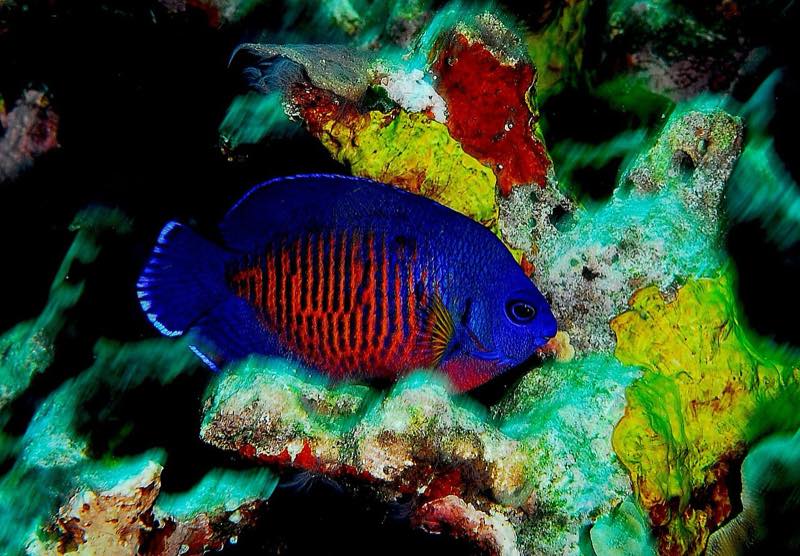
Coral beauty
Centropyge bispinosa
- Care
- Intermediate
- Adult size
- 12 cm
- Tank from
- 265 litres
- Temperament
- Semi-aggressive
- Corals
- Reef safe with caution
Photo Jenny Huang, CC BY 2.0
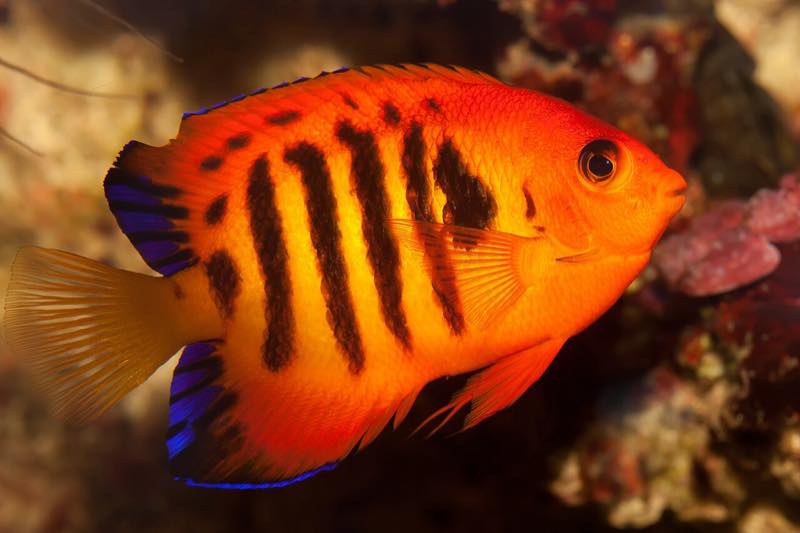
Flame angelfish
Centropyge loricula
- Care
- Intermediate
- Adult size
- 10 cm
- Tank from
- 265 litres
- Temperament
- Semi-aggressive
- Corals
- Reef safe with caution
Photo Andreas März, CC BY 2.0